

As we all know by now, we have been extremely lucky as every storm headed here either dissolves, turns away, or is shattered so much that it is very weak when it impacts Kohala. Thankfully, we do have Mauna Kea, Mauna Loa, and Haleakala to assist in our daily lives.
Now there are 2 more storms headed in our direction, with the first one, Ignacio, having its current track hitting the Big Island as a Cat 1 Hurricane, with winds around 85mph sometime Tuesday, 3am. The 2nd Hurricane, Jimena, isn’t far behind, but its current tracking shows it going West of us, but as a huge Cat 4 Hurricane. All trackings are educated guesses so anything can happen and change, so be prepared. Have plenty of food, water, gasoline, batteries, and radio, just in case, and stay tuned to KNKR, 96.1fm for all the updates as well as here, on KNKR.ORG. Below are the details.


Ignacio continues to produce cloud tops colder than -80C near the
center.  A recent GPM over pass showed a 20-25 n mi wide eye
forming under the overcast.  However, the eye is ragged, and the
deep convection in the eyewall is mainly southwest of the center.
Satellite intensity estimates from TAFB and SAB are 90 kt and 77 kt,
and the CIMSS Advanced Dvorak Technique is estimating 80 kt.  Based
on these data, the initial intensity is increased to 80 kt.

The initial motion is now 285/11.  There is little change in the
forecast philosophy since the previous advisory, with the
subtropical ridge north of Ignacio expected to steer the cyclone
generally west-northwestward through the forecast period with a
gradual decrease in forward speed.  Some spread in the track
guidance develops by day 5, as the ECMWF turns a weaker Ignacio
westward while the GFS turns a stronger Ignacio northwestward.
Despite this, the consensus models and the center of the guidance
envelope are near the previous forecast, and the new forecast is a
slightly faster update of the previous forecast.

Ignacio should remain over warm sea surface temperatures and in an
environment of light vertical wind shear for at least the next two
days, which should allow continued strengthening to a major
hurricane.  After that time, the cyclone should encounter increasing
westerly shear and move over slightly cooler water, which should
start a gradual weakening.  The new intensity forecast follows this
scenario and is basically unchanged since the previous advisory.
One note of uncertainty in the intensity forecast is that the GFS
shear at day 5, which is used in the SHIPS and LGEM models, looks
weaker than that forecast by the ECMWF and UKMET models. Should the
latter models verify, Ignacio could weaken faster than currently
forecast.

Ignacio is expected to move into the Central Pacific basin at about
1800Z.
FORECAST POSITIONS AND MAX WINDS
INIT  27/1500Z 12.9N 139.5W   80 KT  90 MPH
 12H  28/0000Z 13.6N 141.1W   90 KT 105 MPH
 24H  28/1200Z 14.5N 143.1W   95 KT 110 MPH
 36H  29/0000Z 15.4N 144.8W  100 KT 115 MPH
 48H  29/1200Z 16.1N 146.1W  100 KT 115 MPH
 72H  30/1200Z 17.5N 149.0W   95 KT 110 MPH
 96H  31/1200Z 19.0N 151.5W   85 KT 100 MPH
120H  01/1200Z 20.5N 154.0W   75 KT  85 MPH

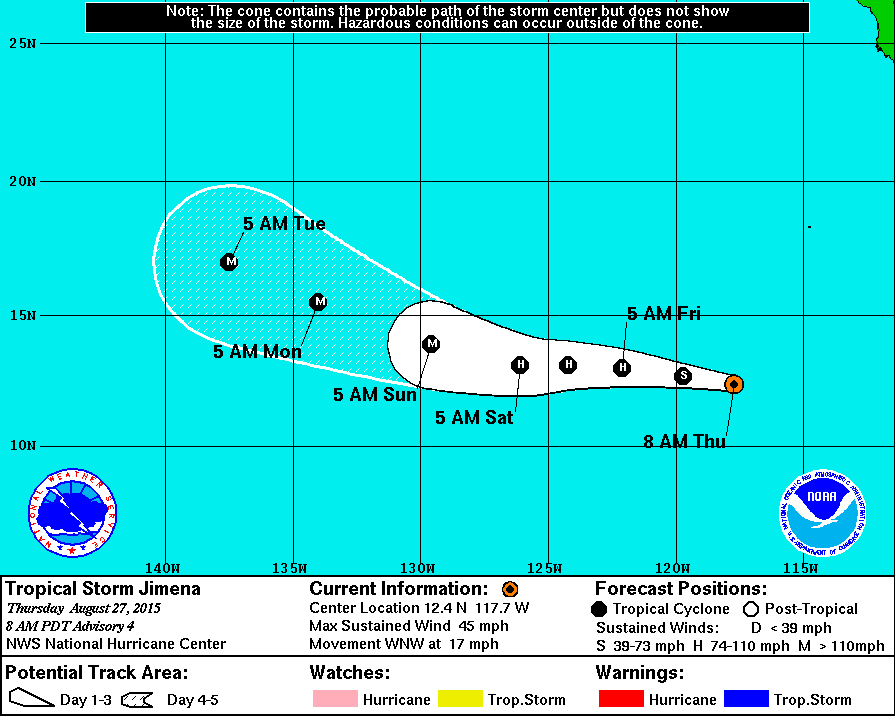
Jimena is steadily becoming better organized with deep convection
persisting near the center and more pronounced banding developing
around the circulation.  The initial intensity is 40 kt based on
Dvorak estimates of T2.5/35 kt from TAFB and T3.0/45 kt from SAB.
Embedded in an environment of low shear, high moisture, and very
warm ocean water, Jimena should have no problems continuing to
intensify.  In fact, rapid intensification (RI) is a distinct
possibility during the next 24 hours.  A low-level inner core ring
was noted in the 37-GHz channel of a 0946 UTC GPM microwave pass,
and the SHIPS RI index is showing a 1 in 3 chance of a 30-kt
intensity change during the next 24 hours.  Therefore, the NHC
intensity forecast shows Jimena becoming a hurricane on Friday.
After 24 hours, the overall environment should remain favorable for
strengthening, and Jimena is forecast to be a major hurricane from
day 3 through day 5.  The updated NHC intensity forecast is a
little higher than the IVCN intensity consensus and shows a bit
more strengthening than the previous forecast through 96 hours.

The storm has been moving quickly west-northwestward with a 12-hour
motion of 285/15 kt.  A strong deep-layer ridge extends from
northwestern Mexico to just east of the Hawaiian Islands, and this
feature should steer Jimena generally westward during the next 48
hours.  A weakness is expected to develop in the ridge by 72 hours,
which should turn the cyclone west-northwestward through day 5.  The
track guidance has shifted slightly southward during the first 48
hours, and the updated NHC track forecast follows suit but still
lies a little north of the model consensus.  The updated forecast is
largely unchanged from the previous one after 48 hours.

FORECAST POSITIONS AND MAX WINDS

INIT  27/1500Z 12.4N 117.7W   40 KT  45 MPH
 12H  28/0000Z 12.7N 119.7W   50 KT  60 MPH
 24H  28/1200Z 13.0N 122.1W   65 KT  75 MPH
 36H  29/0000Z 13.1N 124.2W   80 KT  90 MPH
 48H  29/1200Z 13.1N 126.1W   90 KT 105 MPH
 72H  30/1200Z 13.9N 129.6W  105 KT 120 MPH
 96H  31/1200Z 15.5N 134.0W  115 KT 130 MPH
120H  01/1200Z 17.0N 137.5W  115 KT 130 MPH